

Employee Ownership explained: What are the different models and could one work for your business?
Employee ownership is a way of structuring a business so that employees have a meaningful stake in the company they help to build. While many people associate employee ownership solely with an Employee Ownership Trust (EOT), there are several different ways a business can become employee-owned, depending on its goals, size, culture and future plans.
In this blog, Robert Postlethwaite, Founder and Managing Director, explains what employee ownership means, the different models available, and how to decide whether it could be the right option for your business.
At a recent legal networking event one of my colleagues was explaining what their work involved. The conversation went something like this:
“Tell me about about your firm and what you do”
“Oh, we’re specialists in employee ownership”
Slight look of concern from the questioner: “Employees being owned? Isn’t that slavery?”
Cue my colleague explaining that employee ownership is actually about employees owning the organisation in which they work, the precise opposite of slavery, and in my view, of great importance for our future economic success.
Why do businesses choose employee ownership?
Employee ownership is a powerful tool to improve business performance, with plenty of evidence to show that benefits can include enhanced business productivity, profitability and resilience, with more engaged and purposeful employees. Put simply, providing employees with a stake in their company provides additional rewards linked to business performance and allows them to help shape how their company can do better
It also has a vital wider role in society. In an era where wealth is becoming concentrated in the hands of fewer and fewer people, many feel that our current system is failing to deliver for them. Against a backdrop of AI advancing as quickly as it is, it has the potential to turbocharge the wealth gap.
But by increasing the share of business success that goes to the employees who have helped generate it, employee ownership can help address income and wealth inequality, a challenge we cannot afford to ignore.
Like any useful tool, employee ownership needs deft handling. It’s not enough just to create employee owners, they must feel engaged in their business’s success and be able to work together to improve it.
What are the different types of employee ownership?
Employee ownership can take many forms. What they all have in common is that all or most employees in a business have a stake in its financial success and an ability to help shape how it can perform better.
The “most employee-owned” a business can get is when it’s 100% owned by (or on behalf of) everyone working there. However, a business can still rightly be considered employee-owned if a smaller percentage is owned by its employees. Here we explore the different types of employee ownership models and structures available to business owners.
100% employee-owned
Many UK private companies are now entirely owned by their employees. Often this will involve an employee ownership trust (EOT) holding all the shares on their behalf.
We at Postlethwaite have adopted this model, one of a few UK legal firms that are 100% employee owned.
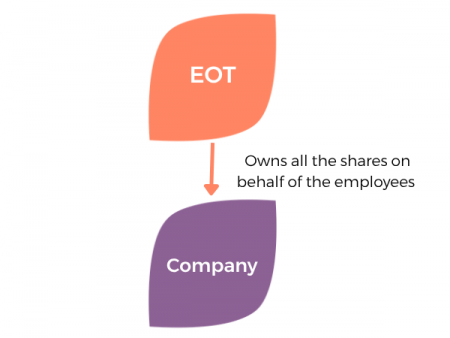
Graphic 1. 100% Employee Owned EOT Structure
Majority employee-owned (often called hybrid employee ownership)
It is also common for employees to own more than 50% alongside other owners (most commonly founder/owners, senior management, or investors). In most cases, again the employees’ stake will be held in an EOT.
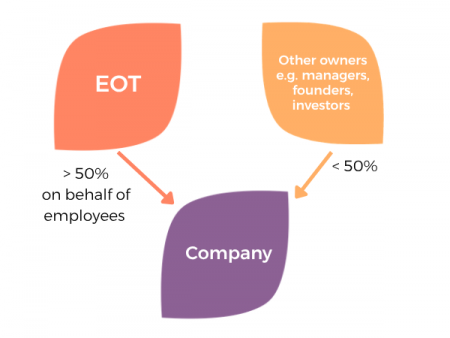
Graphic 2. Majority Employee Owned via an EOT
How does a company become 100% or majority employee-owned?
It is perfectly possible to start a new business that is entirely or majority employee-owned.
However, in the UK employee ownership through an EOT mainly comes about as a key part of succession for a business’s founders, who transfer their shares (or a majority of them) to an EOT, normally being paid for them over time from the company’s future profits.
The EOT has two principal tax advantages. Founders who sell more than 50% of their company to an EOT enjoy a 50% reduced rate of capital gains tax. Employees can also be paid an annual bonus free of income tax up to £3600.
What are the other forms of employee ownership?
For some companies, 100% or majority employee ownership may not be feasible. Founders may either not be ready to give up control, or they may feel a smaller employee stake will work better.
The good news is that there are plenty of ways in which an employee ownership stake can still be created.
Management-led sale to create a Management and Employee Buy-Out (MEBO)
Where a company’s founders are ready to sell and want the business to retain its independence, they may sometimes favour a management buyout (MBO). This will typically involve members of the management team forming their own new company (Newco) in which they are the shareholders, which then buys the shares in the founders’ company.
Of course, this on its own doesn’t create any employee ownership. But this can be fixed by, for example, an EOT joining the management team as owners of the Newco. The management team may wish to hold a majority of shares, so the EOT’s stake will generally be a minority (typically 10-49%). The management buyout then becomes a management and employee buyout (MEBO).
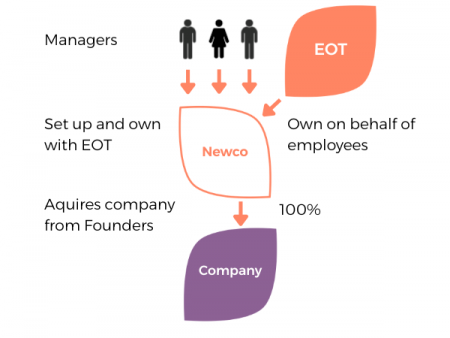
Graphic 3. Management and Employee Buyout Structure
Creating an employee ownership stake without a fundamental change of ownership
So what does a company do if it wants to create an employee ownership stake but without the current owners/shareholders giving up control? Here, are several choices to be considered.
An EOT purchases a minority stake (less than 50%)
An EOT could, for example, acquire a 10-20% stake:
Although the EOT would not control the company (so would not, for example, have power to determine who were its directors), this kind of minority stake could, if combined with agreement that employees would receive a profit share that matched their percentage ownership, create a significant and worthwhile form of employee ownership.
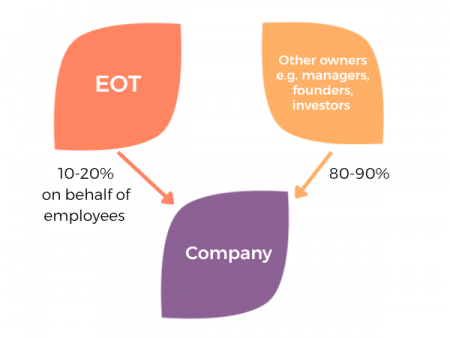
Graphic 4. Minority Employee Ownership Stake
Employee Share Schemes
Individual employees acquire shares personally
So far we’ve only looked at an EOT to create employee ownership, which has the practical advantages of no financial risk for employees and having few moving parts (no need to arrange for new employees to acquire shares or departing employees to sell).
But there are situations where individual employee share ownership might be seen as more attractive, particularly where employee ownership will involve less than 50% of the company and so the EOT tax reliefs won’t be available.
Although individual share ownership involves more administration, some companies may prefer it because it provides every employee with their own personal investment which they can potentially sell in the future at a gain if their company prospers. And if employees purchase shares, the financial risk might be seen as an additional performance incentive.
Also, the EOT is mainly intended for use by UK private SME companies. We shouldn’t ignore how public companies can – and often do – create opportunities for all their employees to acquire shares. After all, we estimate that at least 6 million UK employees work for companies whose shares are listed on a stock exchange.
Here are some key ways in which employees can acquire shares personally:
- Purchasing shares (income tax relief is available if this is done through a share incentive plan)
- Free shares (employees don’t pay income tax on their value if the award is made through a share incentive plan.
- Share options (employees are granted a right to acquire shares from a future date but at a fixed price). Tax incentives are available if options are granted as Enterprise Management Incentives (EMI), Company Share Option Plan (CSOP) or Save As You Earn (SAYE)
Achieving a positive impact on your business and its people
Once you’ve chosen what kind of employee ownership is best for your company, it will be essential to plan to skill up your team to use this tool as effectively as possible. This is all about engaging your employees in business performance, sharing financial information in an engaging and accessible way, empowering them to assume a shared responsibility for improvement – all on the foundation of a real stake in any resulting success.
How Postlethwaite Solicitors can help you introduce employee ownership
In our over twenty years of practice, we have helped many businesses, across multiple sectors, find a way to involve their employees as owners in a way that suits their own commercial needs, culture and maturity. Everything from employee ownership trusts or management and employee buyouts for succession to employee share schemes to create a stake for employees in their company's future growth.
If you’d like to find the best way to create employee ownership to suit your company, speak with one of our trusted experts via our contact us page here.